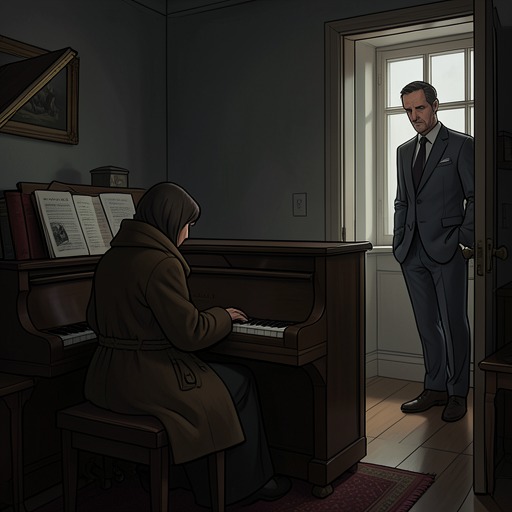
“I Don’t Know How to Love Him”
All My Puny Sorrows“I Don’t Know How to Love Him” is a song from Jesus Christ Superstar that Yolandi Von Riesen sings to her sister, Elfrieda Von Riesen, while Elfrieda lies in intensive care. Their shared songbook gives the bedside scene a history of intimacy, but the performance cannot resolve Yolandi’s fear or Elfrieda’s distress; its significance lies in the attempt to remain connected when ordinary conversation has failed.
The Song and Its Shared History
Yolandi recalls that she and Elfrieda used to belt out the song together. In the musical, it is Mary Magdalene’s passionate ballad about her attraction to Jesus and her effort to understand that desire by treating him as an ordinary man. Yolandi remembers the song’s emotional intensity and its unlikely subject with affection, but does not turn the scene into a comic performance: at Elfrieda’s bedside, she sings quietly.
The song’s title also sits beside a broader difficulty around the language of love. In another conversation, Elfrieda explains that repeating the word “love” has begun to make her feel panicked and tearful; it no longer works for her as a sustaining mantra. The book does not explicitly connect that exchange to the song, but together the moments show how a familiar word or song can carry different weight when Elfrieda is suffering.
A Song in the Intensive-Care Room
Yolandi offers to sing after sitting with Elfrieda as evening falls. Elfrieda’s breathing machine provides the steady sound in the room, and the corner of her mouth moves slightly when Yolandi offers. Unsure what to choose, Yolandi settles on the song the sisters once sang together and performs it softly as the room grows dark. The remembered duet has become a solitary effort, but it draws on something they shared rather than demanding an answer from Elfrieda.
After Yolandi stops singing, Elfrieda writes a question on a pad of paper asking how to continue. The exchange makes clear that the song has not supplied an answer: Elfrieda communicates in writing, and Yolandi cannot tell her what to do. They close their eyes while time passes. When Elfrieda does not respond to Yolandi calling her, Yolandi rests her head gently against her sister’s stomach, where Elfrieda imagines a glass piano inside her, and admits to herself that she does not know what to do.
Music and Communication
The bedside performance places music among the forms of expression available when speech is limited. Elsewhere, Elfrieda’s imagined glass piano makes sound a source of fear: bottles, wind chimes, and a bird’s call can seem to her like the instrument breaking inside her. The song is not presented as a cure for that fear, nor does the scene claim that music makes Elfrieda well. Instead, Yolandi’s quiet singing is a personal gesture rooted in their shared past, set against a moment when she cannot find a verbal response to her sister’s written question.
That distinction matters within a story attentive to how patients are heard. Elfrieda sometimes refuses to speak, and a psychiatrist dismisses the effort of communicating with her through written notes. Yolandi’s singing does not replace Elfrieda’s own means of expression; it accompanies her while she writes. The song thus marks both the closeness between the sisters and the limit of what closeness can accomplish: Yolandi can offer a familiar melody, but she cannot make it answer the question Elfrieda has put on the page.